Why I’m Building an AI Delivery Workflow
Why I am trying to turn scattered AI, GitHub, and deployment tools into one practical delivery workflow.
AI tooling has gotten good enough to be useful, but for most technical builders it still does not feel like a real operating system.
You can open ChatGPT, Claude, Copilot, Codex, or another coding agent and get something helpful. You can ask for code, explanations, refactors, commands, and plans. You can connect pieces of your stack. You can automate parts of your workflow.
But most of the time, it still feels scattered.
That is the problem I care about right now.
I am not especially interested in AI as a toy, a gimmick, or a source of endless screenshots. I am interested in whether it can become a practical delivery layer for real work.
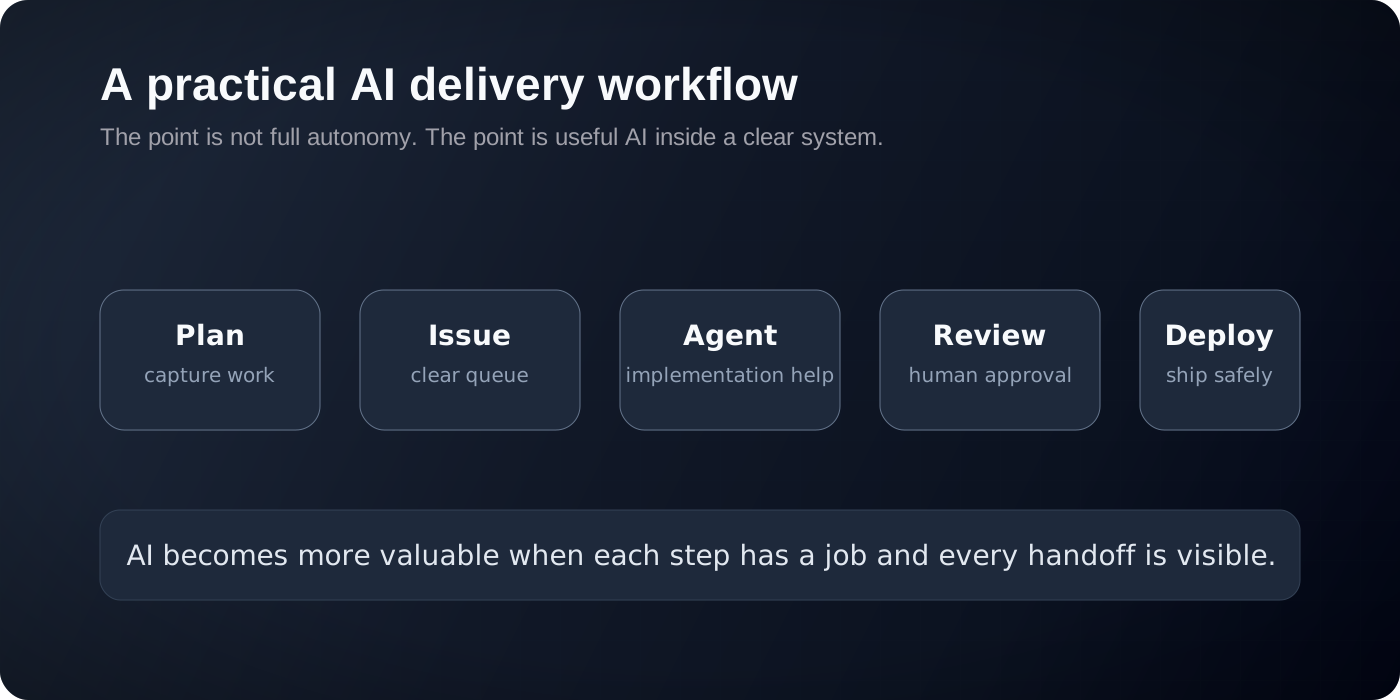
I want something that helps move a project from idea to issue, from issue to implementation, from implementation to review, and from review to deployment without turning the whole process into chaos.
That is what I mean by an AI Delivery Workflow.
Not “AI does everything”
When people hear language like this, it is easy to imagine a fully autonomous setup that replaces judgment, skips review, and magically runs the whole software lifecycle on its own.
That is not what I am building.
I do not think the goal is to hand over the keys and hope for the best. I think the goal is to build a workflow where AI is genuinely useful inside a system that still has structure, boundaries, and human decision points.
In practice, that means:
- issues still matter
- review still matters
- deployment boundaries still matter
- human approval still matters
The value is not that AI replaces the workflow. The value is that AI becomes productive inside the workflow.
The problem with the current tool landscape
Right now, there are a lot of individually impressive tools:
- coding agents that can implement real changes
- systems like OpenClaw that can act more like an operating layer than a chat box
- GitHub issues and pull requests that already provide a clean work queue
- GitOps tools like ArgoCD that create a sane deployment path
But if you are a technical builder, platform engineer, founder, or operator trying to actually use these tools together, the path is still fuzzy.
You can usually get one piece working. You can often get two or three pieces working.
What is harder is getting the overall system to feel coherent.
That is where most of the friction lives:
- What tool should do what?
- Where should work begin?
- How do you keep agents from becoming disconnected chat assistants?
- How do you make GitHub the queue instead of a side effect?
- How do you preserve review and deployment discipline?
- How do you make the whole thing feel usable instead of fragile?
That is the gap I want to close.
What I’m actually building
I am working toward a practical operating model built around a few core ideas:
- OpenClaw as the coordinating layer
- GitHub issues as the work queue
- coding agents as implementation helpers, not independent bosses
- pull requests and review as quality and control points
- ArgoCD and Kubernetes as the deployment path
That stack will not be right for everyone. It is opinionated. It assumes some technical comfort. It is not a beginner course and it is not trying to be one.
But for the kind of builder I care about here, it solves a real problem: how to turn a pile of promising AI and infrastructure tools into a workflow you can actually trust.
Why this matters to me
I do not want to spend my time bouncing between disconnected tools, each of which is impressive in isolation but awkward in combination.
I want a workflow that helps me do delivery work with more leverage and more clarity.
I want to be able to:
- capture work cleanly
- delegate parts of implementation to agents
- review changes with clear boundaries
- ship through a real deployment path
- understand what the system is doing and why
That last point matters a lot.
I am not trying to build a black box. I am trying to build a workflow that increases confidence.
What this series will cover
This is the frame for a broader set of writing and operator material I plan to publish.
Some of it will stay public. Some of the more structured playbooks, checklists, and deeper workflow material will eventually live as paid member content. But the goal is the same across all of it: make this stack more understandable, more usable, and more practical.
The first implementation article in that series will be about getting OpenClaw running on Kubernetes in a way that fits this broader workflow direction.
That matters because I do not want the install guide to feel like an isolated technical note. I want it to sit inside a more complete point of view:
AI becomes much more useful when it is part of a delivery workflow instead of just another chat window.
What this is not
To keep this grounded, it is worth saying what I am not trying to do.
- I am not promising full automation.
- I am not saying AI replaces engineering judgment.
- I am not building a generic prompt guide.
- I am not treating Kubernetes, GitHub, and agent tooling like magic.
- I am not trying to create a hypey “one weird trick” system.
I am trying to create a workflow that a technically capable person can actually operate with confidence.
The real goal
If this work goes well, the outcome is not just “I have OpenClaw installed.”
The outcome is something better than that:
- I understand the stack
- I know what each part is for
- I can move work through it with less friction
- I trust it enough to use it on real projects
That is the standard I care about.
That is why I am building an AI Delivery Workflow.
And that is the direction this series is going next.